
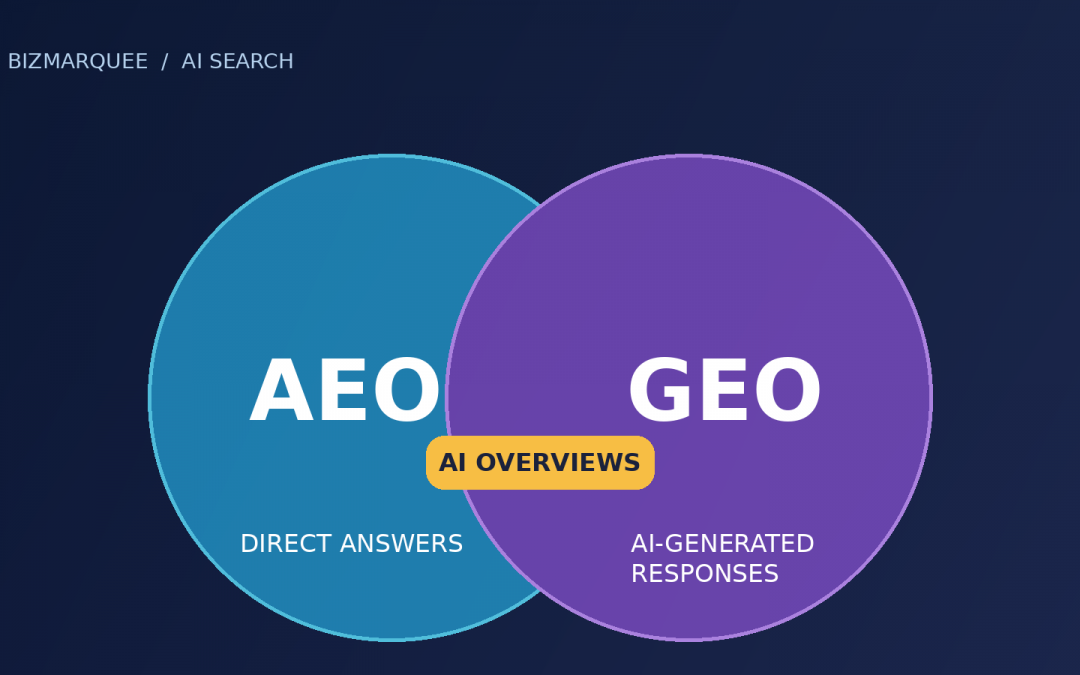
AEO and GEO are related, but they are not twins—and they are definitely not “Google versus ChatGPT.” That neat division sounds useful until Google generates an AI Overview, ChatGPT gives a direct answer, and everyone at the acronym meeting starts moving the name tags.
Here is the working distinction: answer engine optimization (AEO) is about making your information a useful direct answer. Generative engine optimization (GEO) is about how your information appears in an AI-generated response—as a source, a citation, a brand mention, or a fact that shapes the answer. A Google AI Overview can be both. So can a sourced ChatGPT answer.
These are industry terms, not two official, mutually exclusive channels. Google Search Central says AEO and GEO are labels people use for AI-search visibility, while Google considers optimization for its generative Search features part of SEO. That is a good warning against selling three different invoices for one paragraph of useful content.
What AEO actually means
AEO focuses on the answer format. The user asks a question and a platform tries to answer it immediately, often before anyone clicks a traditional result. A classic example is a Google featured snippet. Another is a spoken answer. Today, it can also be an AI Overview or an assistant’s concise reply.
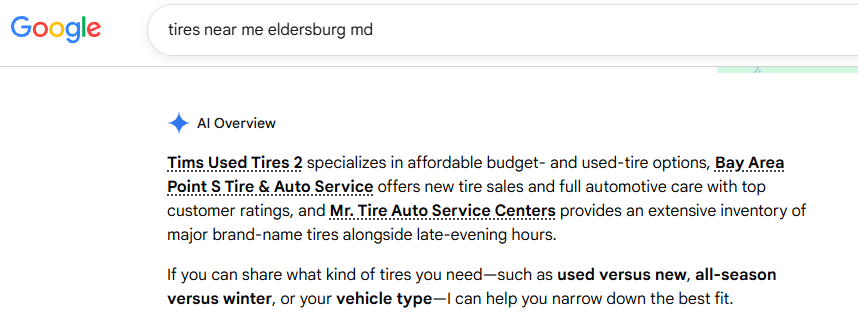
Imagine an auto repair shop page answering, “What are the right tires for a 2011 Infiniti QX56?” AEO work would give the customer a clear path: explain that fitment depends on the vehicle’s exact wheel and tire specifications, load requirements, and how it is driven; show how to confirm those details; and tell the reader how the shop checks suitable options. “We keep you rolling” is a fine slogan, but it is not a tire recommendation. Neither is confidently naming a size for a vehicle you have not inspected.
Do not confuse optimizing for an answer with guaranteeing the answer box. Google says you cannot mark a page as a featured snippet; its systems decide whether to show one. Good AEO work improves the underlying page. It does not provide a “make me the answer” checkbox, regardless of what a plugin’s sales page implies.
What GEO actually means
GEO focuses on the generative system and its output. A model may retrieve several sources, compare them, synthesize a response, and decide which pages to cite. The original GEO research paper discussed generative engines broadly, including Google’s early generative search, Bing Chat, and Perplexity. GEO was never defined as “everything except Google.”
In our auto repair example, the customer might ask, “Which tires make sense for my 2011 Infiniti QX56 if I do highway driving and occasional winter trips, and which local shop can help me choose?” A generative system could compare vehicle specifications, tire information, shop pages, and reviews. GEO asks whether your shop is discovered, described accurately, and cited where appropriate in that comparison. Being named without a citation is different from having your tire-fitment page linked; both are different from earning a call or an appointment.
Those distinctions matter because a generated response has no stable “number one ranking” in the old top-ten-blue-links sense. The wording of the question, available sources, and the system’s behavior can change the response. Microsoft’s AI Performance report therefore tracks cited pages and grounding-query themes across supported AI experiences, while warning that citation counts are not rankings or traffic.
Where AEO and GEO overlap
Google AI Overviews are the obvious overlap. They answer questions directly, so they fit AEO. They also generate a response grounded in retrieved pages, so they fit GEO. Google’s own documentation explains that AI Overviews and AI Mode use its Search index and may fan a question out into related searches before composing an answer. The underlying crawlability and quality of the page still matter. Google’s AI-features guide says a page must be indexed and eligible for a Search snippet to appear as a supporting link.
ChatGPT, Claude, Perplexity, and Copilot (LOL) can overlap too when they provide direct answers using retrieved sources. The platform is not the definition. What the system does with the information is the definition. If it delivers an answer, AEO is relevant. If it generates and synthesizes an answer, GEO is relevant. Sometimes that is the same screen. Acronyms do not get exclusive custody of the pixels.
Why not just call everything the same thing?
You’d like that wouldn’t you? Because the distinction forces a better measurement plan. For a classic featured snippet, you might inspect the query, the displayed snippet, Search Console performance, and clicks to the page. For a generative answer, you may need to inspect whether your brand appears, whether it is described correctly, which page is cited, and whether the citation persists across representative questions. A direct answer can be useful even when no citation appears; a citation can be valuable even when few users click it. They are related outcomes, not interchangeable numbers.
It also prevents lazy assumptions about distribution. A page indexed by Google is not automatically available to every assistant. For ChatGPT search, OpenAI advises publishers to allow OAI-SearchBot if they want content included in summaries and snippets. Conversely, chasing a particular crawler will not rescue a page that never clearly states what the business does.
What should a business actually do?
- Start with SEO fundamentals. Make important pages accessible, internally linked, and useful. Google says its established SEO practices remain relevant to AI Overviews and AI Mode.
- Write answerable content. State real policies, services, locations, prices where appropriate, and limitations in visible text. Use descriptive headings, then answer the question beneath them.
- Back up claims. First-hand examples, clear credentials, current information, and original photos help people evaluate your business. They also give an assistant something more useful than another paragraph of “unparalleled excellence.”
- Keep structured data honest. Schema can support eligible rich results, but Google says no special schema is required for its generative AI features. Mark up what is actually on the page; do not treat schema as a secret AI incantation.
- Measure by surface. Watch traditional search performance, inspect Google AI results for relevant questions, review available AI citation reports, and test the same customer scenarios across assistants. Record mentions, citations, accuracy, and resulting business outcomes separately.
——————–
AEO asks, “Can we be a useful answer?” GEO asks, “When AI composes an answer, are we represented and sourced accurately?” Both sit on the foundation of good SEO. The overlap is real, especially in Google AI Overviews and sourced assistant responses. The separation is useful only if it helps you make better pages and measure the right results—not if it gives the industry two more labels to put on the same spreadsheet.
And let’s not confuse any of this with EIEIO which is just simply that an old man had a farm…that has sadly been acquired via eminent domain and turned into a Costco. Sorry to ruin everyone’s childhood. Ask ChatGPT for a good therapist near you. You’re welcome.